The Grace I Struggle to Receive
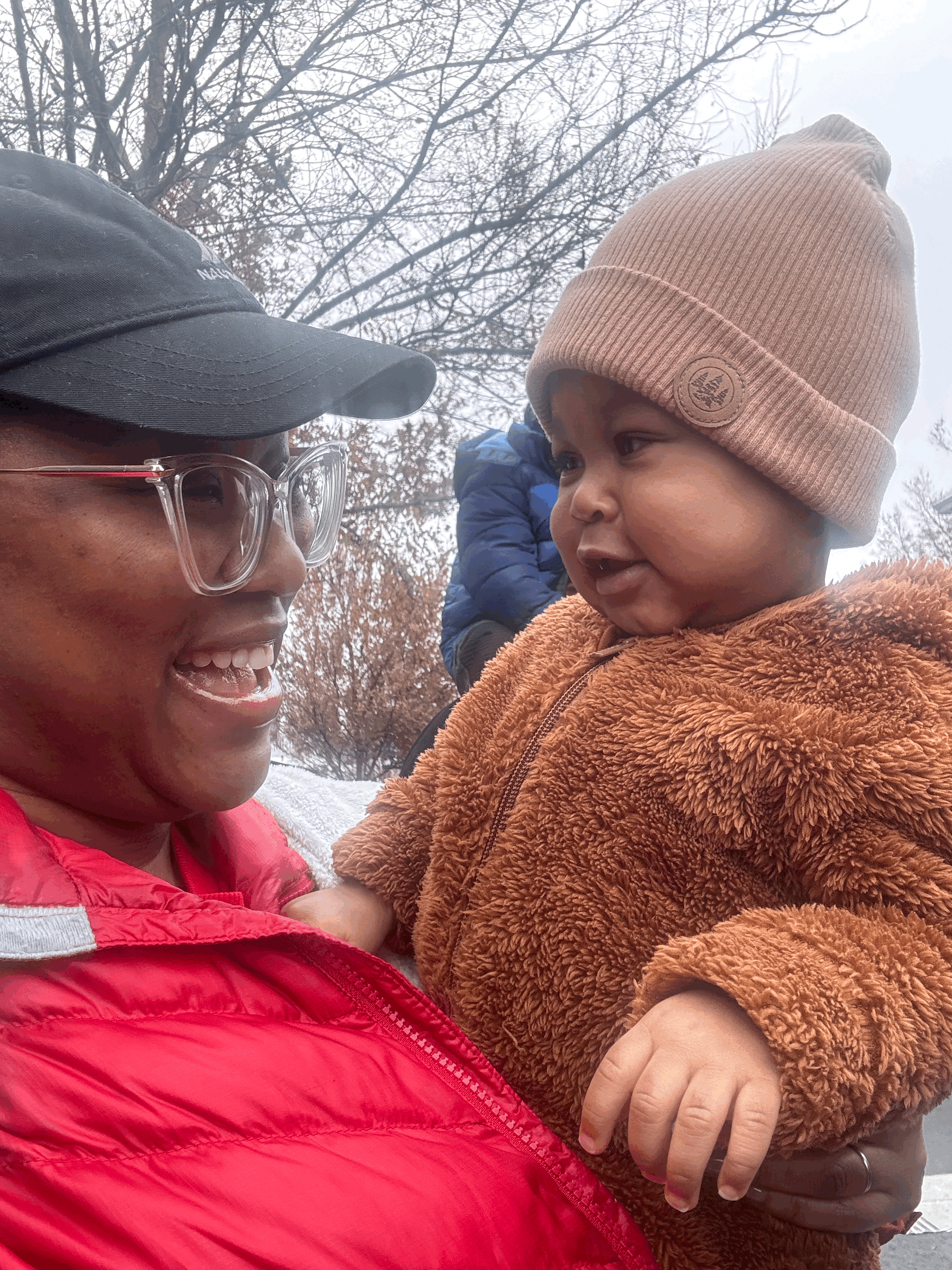
Me and my youngest adventurer, Noah
About 2 weeks ago, something happened that I still struggle to write without feeling a pain in my chest.
One minute all 3 of my children are watching a movie on the couch while I am floating through the house doing laundry, cooking dinner, and packing for our upcoming vacation, and the next I am looking for my adventurous 3-year old. Somewhere in the middle of a very normal Sunday afternoon routine, my youngest walked out of the house alone, wearing boxer shorts and a pajama shirt.
His brother and sister did not hear him leave. I did not hear him leave. Twenty minutes passed before I realized he was gone. Another twenty minutes passed before he was brought home safely.
I do not have words creative enough to describe the fear and shame that surged through my body during this time. Panic is too small a word. Fear is too polite.
It was the kind of fear that makes your body move before your mind can fully process what is happening. I ran barefoot from one neighbor’s house to another asking for help. Some checked their cameras. Some comforted me. Some simply stood with me in the awful space between fear and relief once he came home. I called out and screamed Noah’s name. I tried to think clearly while every worst-case scenario fought for space in my mind. I silently prayed for his safe return while also feeling the weight of being the only parent home. I consciously asked myself how I could tell my husband that I had lost our youngest child, WHILE WE WERE HOME?! My mind began to spiral. “I was the one responsible. The one who should have known.” And while I was falling apart inside, my neighborhood rallied around me.
The neighbors who found Noah and brought him home were unbelievably kind. No one shamed me. No one accused me. No one treated me like I was a bad mother. The harshest voice in the entire experience was my own. When Noah saw me, he ran to me and asked me if I could get him a cup of water. He told the neighbors that while looking for me, he began following a bird. I cried and laughed and then cried again at the conclusion of yet another terrifying parenting story that I have lived. But Noah’s physical return was far from the end of this story.
After Noah was home, safe and unharmed, I thanked God over and over again. “Thank You for protecting him. Thank You for bringing him home. Thank You for gracious neighbors. Thank You for mercy.” And I meant every word. But even as gratitude poured out of me, shame settled in beside it. “How did I not know? How did twenty minutes pass? What if something terrible had happened? How could I have missed something so important?”
That is the part I have been wrestling with most.
Not whether God was gracious. I know He was.
Not whether my neighbors were kind. They absolutely were.
Not whether Noah is safe. He is.
The part I am struggling with is forgiving myself for the fact that it happened at all. I feel like I dropped the ball in an inexcusable way. In a way that touched the deepest part of my identity as a mother.
I can make room for mistakes in many areas of life. I can acknowledge that I am human. I can offer compassion to others. I can sit with clients and remind them that shame is not the same as accountability. I can tell other mothers that they are not defined by their worst moments. But when it came to me, all of that truth suddenly became harder to access.
Even though he came home safely, my mind kept returning to what could have happened. That is the cruelty of knowing what could have happened. Your body experiences the relief of safety, but your imagination keeps dragging you into alternate endings. I was not grieving what happened as much as I was haunted by what might have happened.
And if I am honest, part of me believed that continuing to feel terrible was the responsible thing to do.
As if shame could prove I cared. As if self-punishment could guarantee it would never happen again.
As if forgiving myself would mean I was minimizing the seriousness of what happened.
But I am learning that those things are not the same.
I can take something seriously without condemning myself. I can learn from something without living under the weight of it forever. I can make changes and still receive grace. That last part has been a real struggle for me.
Grace.
It is a word I love. A word I believe in. A concept that I have built an entire business around.
Grace for the grieving.
Grace for the overwhelmed.
Grace for the anxious.
Grace for the person trying to become.
Grace for the one who made a mistake.
Grace for the one who is learning.
But after Noah came home, I realized how easily I can believe in grace for everyone except myself.
I could see God’s grace toward Noah. I could see God’s grace through my neighbors.
I could see God’s grace in the fact that my child was returned safely. But I had not considered that grace was also available for me. For the mother who missed it. For the mother who was doing laundry and making dinner and packing bags and managing multiple things at once. For the mother who did not hear the door. For the mother who searched in terror. For the mother who thanked God with shaking hands and a trembling voice. For the mother who kept replaying the moment long after her child was already safe.
That realization has undone me a little. Because it revealed an expectation I did not know I was carrying: that as a mother, I should somehow be limitless.
I should hear everything.
Notice everything.
Prevent everything.
Anticipate everything.
But only God is all-seeing. Only God is everywhere at once. Only God can hold every possibility, every danger, every child, every breath.
I am a mother.
I am not God.
That does not absolve me of responsibility. It puts my responsibility in its rightful place.
There are practical lessons I have taken from this. We have added additional locks to every externally facing door in our home. My son can barely touch the door now without someone else knowing. On vacation last week, my little runner was tethered to me and a book bag with a harness. There are more conversations to have. There are systems to strengthen, because these things matter.
But the spiritual lesson may matter just as much.
I am learning that responsibility without grace becomes condemnation. And condemnation does not make me a better mother. It only makes me a more wounded one.
God’s grace does not mean what happened was not scary.
It does not mean I shrug my shoulders and move on.
It means I allow God to meet me in the truth of what happened without agreeing with the lie that I am now defined by it.
Romans 8:1 says, “There is now no condemnation for those who are in Christ Jesus.”
No condemnation.
Not no reflection.
Not no accountability.
Not no learning.
No condemnation.
That distinction is saving me.
Because I do want to learn. I do want to be wise. I do want to protect my children. I do want to make changes that help prevent this from happening again.
But I also want to stop treating myself as though shame is the price of being a good mother.
It is not.
Love is.
Presence is.
Humility is.
Repair is.
Wisdom is.
And yes, grace is.
My son wandered. My community searched. God brought him home.
And in the aftermath, God has been gently showing me that His mercy did not stop at the front door when Noah walked back inside. It came inside too.
It met the child who returned safely.
It met the neighbors who helped.
And it met the mother who collapsed under the weight of what could have been.
I am still processing.
I am still tender.
I still wish it had never happened.
But I am trying to receive what I believe God is offering me: Not permission to be careless. Not an excuse to ignore what needs to change. But grace.
Grace to learn.
Grace to breathe.
Grace to stop replaying the worst possible ending.
Grace to remember that I am human.
Grace to believe that being human does not make me unworthy of mercy.
And maybe that is the lesson I will carry forward most.
The same grace I celebrate when God gives it to others is also available when I am the one who needs it.
Even when I feel responsible.
Even when I am scared.
Even when I missed something.
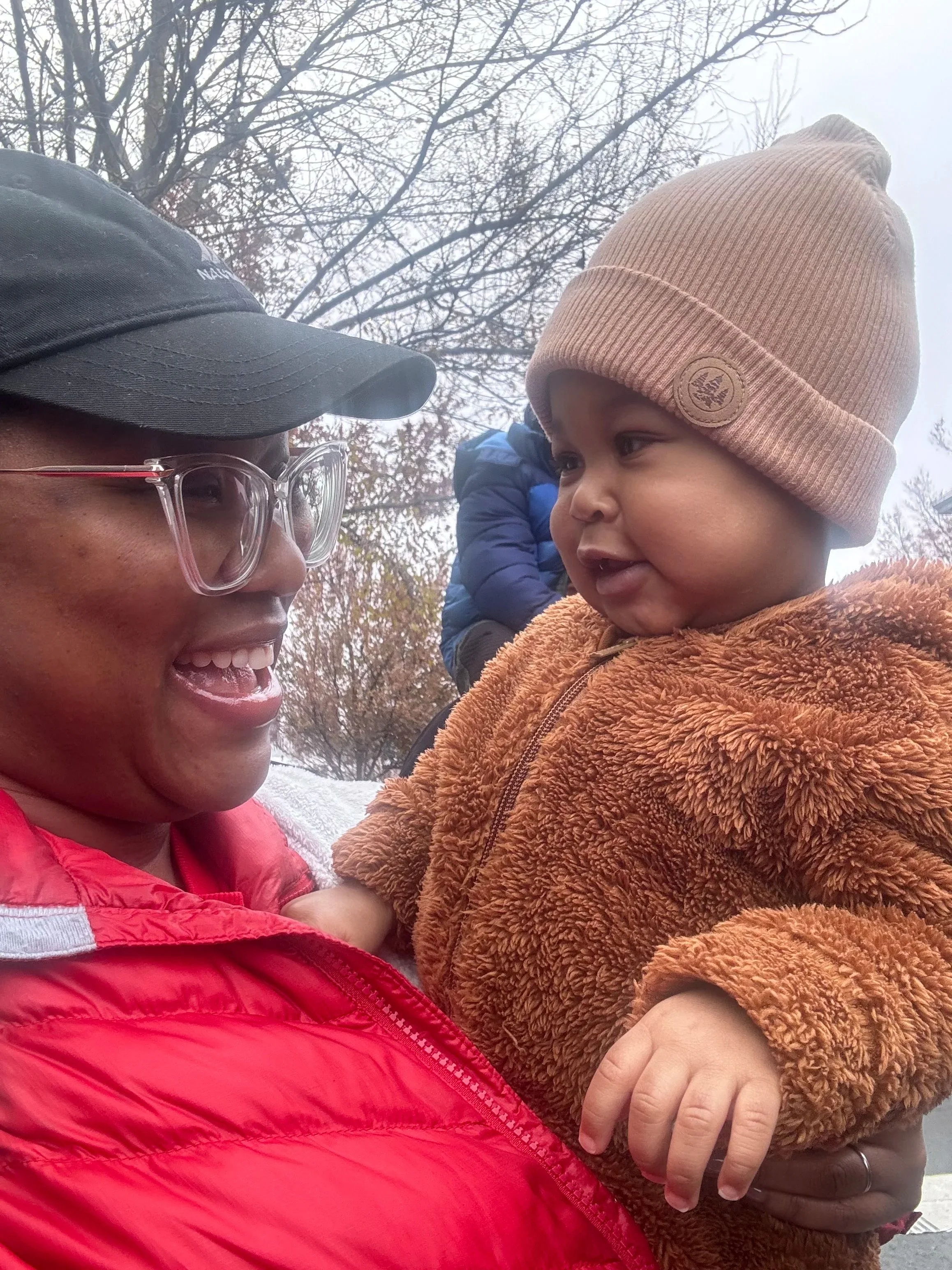
Me and an older photo of my youngest adventurer, Noah
When Regret Meets Grace
what grief, regret, and love are teaching me in real time
I lost my Uncle Bubby recently.
He was one of the kindest, most loving uncles I could have ever asked for. He loved gardening and often told people that smiling was his superpower. And if you knew him, you knew—that wasn’t just something he said. It was something he lived.
When I found out he was sick, the knots in my stomach refused to go away. And still… I didn’t call.
I was too afraid to hear him sound like anyone other than the man I knew—the man who was full of life, warmth, and joy. So I avoided it. I told myself I would call later and see him during my upcoming visit.
Later never came. And I’ll carry that with me.
I’m sharing this because as a therapist, I sit with people in their grief all the time. I hold space for their regrets, their what-ifs, and their longing to rewrite moments they can’t go back to. I talk often about acceptance—about learning to live alongside the things we cannot change. And now, I’m here. Living it.
In the last few weeks, I’ve had to remind myself that grief isn’t linear. My uncle’s funeral was one of six that I’ve attended in the last five months, and I’ve been carrying the weight of one loss after another. I’m learning that it’s okay when that grief shows up unexpectedly—even if it’s just me crying in the kitchen. That it’s okay to not have the capacity to show up for others—and that sometimes, that means canceling sessions with clients.
I’ve had to accept that strength doesn’t always look like holding things together. Sometimes, it looks like letting things fall apart. And if I’m being honest… I’ve had to come to terms with the reality that the only way forward is through this grief—no matter how badly I want to avoid it.
So, here are a few things I’m learning in real time as I navigate this season:
⸻
What I’m Learning in Real Time
1. Grief doesn’t follow rules—and it doesn’t need your permission to show up.
One moment you’re okay, the next you’re crying over something small that somehow isn’t small at all. I’m learning to stop questioning it. Grief moves how it wants to move. My job isn’t to control it—it’s to make space for it.
2. Regret will try to take center stage—don’t let it be the whole story.
I didn’t make the call. And that truth hurts. But I’m learning that while regret deserves acknowledgment, it doesn’t deserve to define the entire relationship. There was so much love there—so many moments that did happen. I’m holding onto those, too.
3. Avoidance feels easier—but it always comes back.
I avoided calling because I didn’t want to face what was real. And now I’m facing it anyway, just in a different form. I’m learning that leaning in—no matter how uncomfortable—is often the kinder choice in the long run.
4. Your capacity will shift—and that’s okay.
There are days when I feel like myself, and days when even simple things feel heavy. I’ve had to cancel, to rest, to step back. Not because I don’t care—but because honoring my limits is part of caring for myself in this season.
5. Strength isn’t pushing through—it’s allowing yourself to feel.
For a long time, strength looked like holding it together. Now, it looks like crying when I need to, saying “this is hard,” and not rushing myself to be okay.
6. The way we love doesn’t end—it just changes form.
I can’t call him. I can’t hear his voice. But I can carry him forward—in the way I show up, in the way I love people, in the way I choose to smile even when it’s hard. His “superpower” didn’t leave—it lives on in the people who loved him.
7. There is still life beneath what feels damaged.
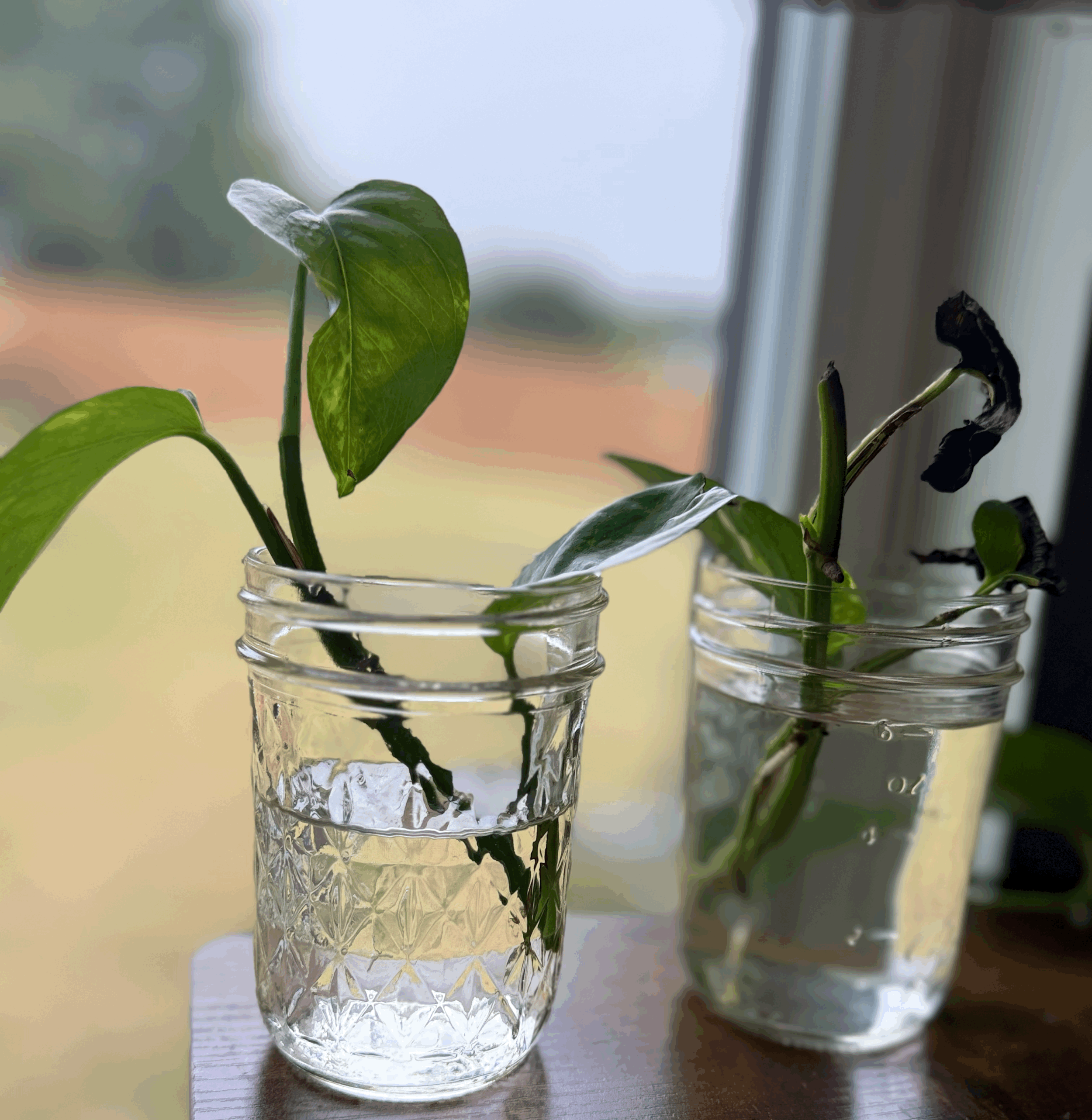
After my uncle’s funeral, I was given clippings from a plant in his home. I carried them in the car window during my eight-hour drive back—which, in hindsight, wasn’t my best decision. By the time I got home, the leaves had turned completely black from the sun.
I remember staring at them before I cried.
It felt like I had lost something else that mattered—something that still felt connected to him.
With a little help, I trimmed away what was damaged and placed the clippings in water, unsure if they would recover. For a while, nothing changed. But over time, small roots began to form. Not in a dramatic or obvious way. Not in a way that I could see right away. But slowly… and beneath the surface.
And I realized—that’s what grief has felt like.
Loss can leave us feeling altered—like parts of us have been impacted in ways we didn’t choose. There are moments that feel heavy, moments that feel raw, and moments that feel like too much to carry.
It’s easy to assume that something is permanently broken when we can’t immediately see healing. But growth doesn’t always happen where we can see it.
Sometimes it’s quiet. Sometimes it’s slow. Sometimes it’s happening even when we don’t feel like anything is changing.
In this season, I am learning that just because something has been damaged doesn’t mean it’s beyond life. Some things are still taking root… even now.
What’s Next
I don’t get to call him. I don’t get to hear his voice or see his smile the way I used to. But I do get to choose what I carry forward.
My uncle used to say that smiling was his superpower. And the more I sit with that, the more I realize—it still is.
So what’s next for me is simple, but not always easy. To keep showing up. To keep loving the people in front of me.
To offer myself the same grace I so easily offer others.
And on the days when grief feels especially heavy… to choose to smile anyway. Not to ignore the pain—but to honor the life, the love, and the moments that made it meaningful.
For me, moving through my grief doesn’t mean leaving people behind. It means carrying pieces of them with us—in the way we live, the way we love, and the way we show up in the world.
⸻
The truth is, there’s no one right way to navigate loss. There’s only your way. Grief may not get easier overnight.
But I am choosing to meet it, moment by moment, with grace in mind.
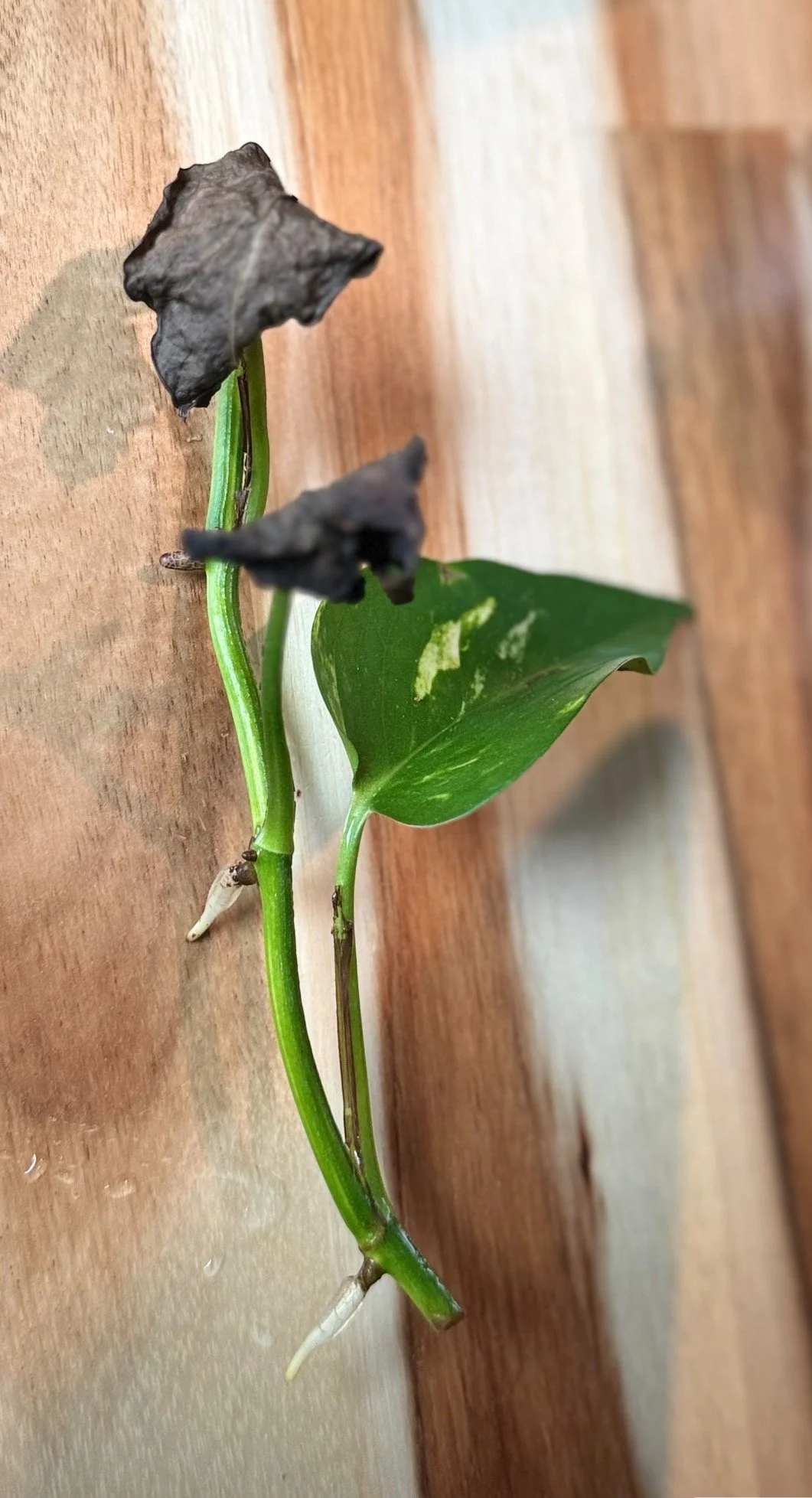
my sun burnt Pothos clipping

Lessons from Wicked
It All Begins Here
Lately, I’ve noticed the same themes in my work with clients. 2025 was hard—personally, globally, financially, spiritually, and emotionally. In 2026, I continue to hear stories of loss, change, exhaustion, rebuilding, and challenges of just getting through each day.
Seeing Wicked reminded me how important relationships are. I’ve loved the show since Broadway in 2010; its message of friendship is deeply personal to me. I was drawn to being a Social Worker & Therapist by a desire to help those who lack the kind of relationships that Glinda and Elphaba represent—relationships where you are seen clearly and accepted fully. Friendships grounded in truth, forgiveness, and genuine care—where conflict doesn’t end connection, repair is possible, and the relationship remains anchored in what matters most.
Many people cope with strength, self-reliance, and resilience—important traits—but we also need true connection.
Having even one place where you don’t have to carry everything alone can support healing, growth, and a sense of steadiness through life’s harder seasons. Thriving doesn't mean doing it alone; it often grows when we let ourselves be known and supported by others. Therapy can offer that kind of safe, contained connection—a space where trust is built slowly, boundaries are clear, and you are met without judgment. Over time, therapy can help people recognize what healthy, reciprocal relationships— rooted in mutual care, honesty, and repair— feel like. Therapy can also help to strengthen individuals’ ability to seek and sustain these relationships beyond the therapy room.
Glinda and Elphaba’s story is more than a fictional bond—it’s a reminder of how deeply we all need safe connection, especially during challenging times. As someone who has performed strength for most of my life, I am learning that we are shaped not only by our strength, but by the places where we are allowed to be seen and supported.
Where could you practice being held, instead of always holding everything together?
When life feels heavy, the presence—or absence—of meaningful connection becomes even more noticeable. As a therapist, I’ve watched people cling to their support systems, redefine relationships, set long-avoided boundaries, grieve friendships that changed, and lean into the people who stayed. These conversations have taught me that friendship and healing share the same roots: being seen, being supported, and being allowed to grow at your own pace.
Here are a few other takeaways:
Hard seasons reveal who is steady. When the world shakes, some people fall away—but others step closer.
Healing isn’t possible in isolation. Even the most independent among us need one safe connection—someone who holds space for our truth.
Repair is part of real relationship. 2025 strained many bonds, and it also created opportunities for honesty, forgiveness, and rebuilding.
Connection looks different for everyone. Some people crave deep friendship. Others prefer quiet companionship, small circles, or intentional solitude. All of these are valid.
🌱 For Those Without a Glinda-and-Elphaba Friendship
I want to acknowledge something gently but directly: not everyone has a friendship like Glinda and Elphaba, and not everyone is looking for one.
You might be walking through life with a small support system, no support system, or simply a preference for independence. You might be recovering from relational hurt or learning to trust again. You might be emotionally tired in ways you haven’t told anyone.
Some people heal in community.
Some heal in the quiet.
Some heal with one safe person.
Some heal with boundaries, rest, or temporary solitude.
Whatever path you are on, your path is just as meaningful, and your season is just as valid.